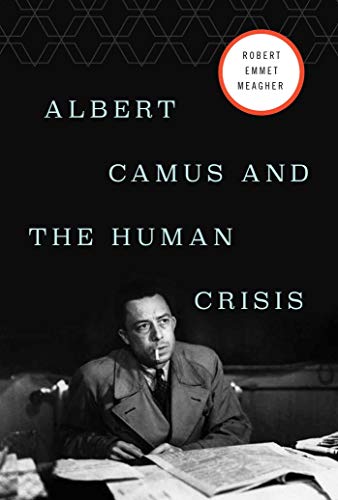
Albert Camus and the Human Crisis / Robert Emmet Meagher
Material type: TextLanguage: English Publication details: New York : Pegasus Books, 2021Description: xi, 234 p. : ill. ; 24 cmISBN:
 - 9781643138213
- B2430.C354 .M42 2021
| Item type | Current library | Home library | Call number | Status | Date due | Barcode | |
|---|---|---|---|---|---|---|---|
 English Books
|
GETS Theological Seminary Library | GETS Theological Seminary Library | B2430.C354 .M42 2021 (Browse shelf(Opens below)) | Available | 00031035 |
Browsing GETS Theological Seminary Library shelves Close shelf browser (Hides shelf browser)
| No cover image available | No cover image available | No cover image available |

|
No cover image available | No cover image available | No cover image available | ||
| B2430 .R552 2007 History and Truth / | B2430 .W473 .P413 2002 Gravity and grace / | B2430.B4 .E72 1998 Creative evolution / | B2430.C354 .M42 2021 Albert Camus and the Human Crisis / | B2430.F724 .E7513 2016 米歇尔·福柯传 / | B2430.F724 .S37 2003 Foucault and Augustine : reconsidering power and love/ | B2430.M33 .R32 1952 The range of reason / |
The human crisis -- Mortality -- Happiness -- The zero point -- Prison -- Toothing-stones -- Plague -- Rats -- Revolution -- Revolution -- Rebellion -- Limits -- Hell -- Judgment -- Friendship -- Conclusion. "A renowned scholar investigates the "human crisis" that Albert Camus confronted in his world and in ours, producing a brilliant study of Camus's life and influence for those readers who, in Camus's words, "cannot live without dialogue and friendship. As France--and all of the world--was emerging from the depths of World War II, Camus summed up what he saw as 'the human crisis'. 'We gasp for air among people who believe they are absolutely right, whether it be in their machines or their ideas. And for all who cannot live without dialogue and the friendship of other human beings, this silence is the end of the world.' In the years after he wrote these words, until his death fourteen years later, Camus labored to address this crisis, arguing for dialogue, understanding, clarity, and truth. When he sailed to New York, in March 1946--for his first and only visit to the United States--he found an ebullient nation celebrating victory. Camus warned against the common postwar complacency that took false comfort in the fact that Hitler was dead and the Third Reich had fallen. Yes, the serpentine beast was dead, but "we know perfectly well," he argued, "that the venom is not gone, that each of us carries it in our own hearts." All around him in the postwar world, Camus saw disheartening evidence of a global community revealing a heightened indifference to a number of societal ills. It is the same indifference to human suffering that we see all around, and within ourselves, today."
There are no comments on this title.